Thursday, March 31, 2011

Black Hair: Motions CPR Treatment Shampoo

I finally finished this product after purchasing it awhile ago, and I thought I would write about the results I've gotten from it.

Perhaps it's a "Motions" thing, but again, this product was less than impressive. The shampoo bottle claims that it is meant to help repair and strengthen chemically treated, curly, or frizzy hair. I think I've gotten some of the frizziest hair after using this product. I also didn't get the "CPR" effect (CPR meaning clinical protection and repair) to work out. My hair seemed to break off about the same as if I were using any other product, if not a little bit more.

The thing I can say about this product is that it did do a little better job in the "cleaning" department than the conditioning shampoo did. It stripped my hair of the dirt a little bit better (although it took a lot of shampoo for the full affect) and it had a better and stronger smell than the other shampoo did. I suppose all in all I felt cleaner using this product than I did using the other product.

I wouldn't recommend this product. I simply did not feel as though it did what it was supposed to do for my hair.

I would like to clarify something about this post and the last "Black Hair" post I did. Just because I don't recommend them or they don't work out for my hair doesn't mean they won't work well for your hair. It all depends on the type and health of your hair. For example, the conditioning shampoo worked great when my hair was in horrible, horrible condition, but now that I have it healthier, I've realized that it simply does not fulfill my needs and it is a horrible product for me. Again, though, it could be a fantastic product for you depending upon your hair type.

Sunday, March 27, 2011

Around Harrisburg: Zembo Shrine Circus

I attended this circus with my little sister (Big Brothers Big Sisters!) a couple of weeks ago, and I have to say that I was pleasantly surprised.

This event is fantastic for kids and families. My little sister is 8, and she loved it (in fact, it was her second time seeing it when she was with me). There aren't a lot of animals in the show, though. There are ponies (for pony rides at the beginning), dogs, and pigs. As a result of this, the circus is filled with a lot of acrobatics and tricks.

The most disappointing thing about this circus were the clown acts, the magic act, and the lack of enthusiasm from the crowd. The clown acts simply were dull and weren't full of zest. Although, I have to say that it was a delight interacting with them outside of their act. They would circulate throughout the crowd during the show and the intermission to get the crowd more excited and more engaged. I thought that personal interaction was really cool. As for the magic act, there weren't a lot of tricks. It was basically the same trick over and over again. Finally, the crowd enthusiasm...there really wasn't any. People were so unresponsive it was disappointing. I had hoped for (a) more people in attendance and (b) for more excitement. It almost gave me the sense that I was witnessing the dying days of the circus culture. Sad.

That being said, I think this is a pretty fun event. While it's not a huge circus, it was definitely a cool thing to do during the day on Saturday or Sunday. I'd love to be proved wrong and see people get excited about it. I highly recommend it for next year.

Black Hair Product: Motions Lavish Conditioning Shampoo

This area of my blog is probably more for me than anyone else (which is perfectly fine), but I figured if I'm going to try and remember which products do and don't work for my black hair, then I might as well share it too in case anyone else wants some insight.

I decided that I would start taking the health of my hair and scalp a lot more seriously since I realized after my last relaxer how much damage I had done to it by not giving it the proper time and treatments that it needs. However, this raised the question of what treatments do I need exactly and what products work the best for me? Unfortunately, while my hair takes on the appearance (mostly) of black hair, it doesn't necessarily act like black hair all of the time since I'm also half Caucasian (aka some products are too much for my hair and create a film of nastiness or some products just don't react like they should). Thus, I have a somewhat unique challenge of finding what works and what doesn't.

About a week after my last relaxer I was left with a scalp that flaked, burned (excruciatingly painful), and itched...badly. My hair was also dry and I could tell at the roots that if I didn't do something I was going to be left with a lot of bald spots. Thus, I began to examine everything that I was using and see what was good and what wasn't. (And for the record- my hair is A LOT healthier right now than it had been for years)

This brings me to this entry's topic- Motions Lavish Conditioning Shampoo. I can still remember when I bought this shampoo for the first time. I bought it in my second year in college (a different bottle mind you, but same product) and I thought it was a conditioner at first until it got all sudsy on my head. I was very impressed with the results at the time. My hair was left VERY soft and moisturized, just what my rats' nest was looking for. Ever since then I swore by this product--until now.

After taking this month to examine the results of this product, I've come to the conclusion that is actually a very poor product for my hair. Granted, it does a great job of actually conditioning my hair and doesn't strip my hair like other shampoos do. However, that's just the problem. It does too good of a job, and it doesn't really feel like it leaves my hair clean. It doesn't have a powerful perfume smell either, so I'm left with hair that still smells the same as before I had stepped into the shower and with almost the same feel, but a little silkier, which can sometimes feel more slimy than anything. Hence, you can see why I don't exactly feel clean after using it. Often times, I resort to using other shampoos to actually do the cleaning and then use this shampoo as a "pre conditioner", which isn't necessary when you have a good conditioning routine.

Between the light and not overly appealing smell as well as the lackluster clean it gives, I have to say that I rate this product pretty low (maybe a D). I definitely won't be buying it again.

Recommend? No.

Tuesday, March 1, 2011

Recipe: Velvet Crumb Strawberry Dessert

I made this over the weekend, and I have to say I was very pleased. Once again, it is more of a summer dish, and was a nice little pick-me-up instead of the typically February dreariness. It was a light dessert in the sense that there wasn't a lot of it, and it wasn't too heavy on the sugar.

Taste: Wonderful. I loved how all of the tastes of the strawberry, the cake, and the cream cheese blended together into one smooth, delightful taste. It particularly worked out because the strawberries that I had were slightly on the tart side, so the dessert wasn't sickeningly sweet. The cream cheese, which I was skeptical about, gave it a great twist.

Grade: A

Cooking: For a cake, extremely easy. The recipe calls for a baking mix, which takes a lot of the mixing out of the picture when you're making the cake. In fact, the glaze was the hardest part. It comes together really quickly.

Grade: A

This is a great dessert for the summer or even spring during Easter.

Here's the recipe:

Velvet Crumb Strawberry Dessert (Summer Fresh Fruits and Vegetables, 1989)

1 1/2 cups baking mix (Bisquick)
1/2 cup sugar
1/2 cup milk or water
2 tablespoons shortening
1 teaspoon vanilla
1 egg
Strawberry glaze (recipe below)
2 packages (3 ozs each) cream cheese, softened
1 teaspoon grated lemon peel
1 1/2 cups strawberry halves

Heat oven to 350. Grease and flour round pan, 9 x 1 1/2 inches. Beat baking mix, sugar, milk, shortening, vanilla, and egg in large bowl on low speed, scraping bowl frequently, 30 seconds. Beat on medium speed 4 minutes. Pour into pan. Bake until wooden pick inserted in center comes out clean, 30 to 35 minutes. Cool 5 minutes; invert on serving plate.

Prepare strawberry glaze; cool. Mix cream cheese and lemon peel; spread over top of cake. Arrange strawberries on cream cheese mixture; pour strawberry glaze over strawberries. Refrigerate until set, at least 1 hour. Refrigerate any remaining dessert.

Strawberry Glaze

1/2 cup strawberries
1/2 cup sugar
1 tablespoon cornstarch
1/4 cup water
1/2 teaspoon lemon juice
3 or 4 drops red food color

Mash strawberries. Mix sugar and cornstarch in 2-quart saucepan. Gradually stir in strawberries and water. Cook over medium heat, stirring constantly, until mixture thickens and boils. Boil and stir one minute. Stir in lemon juice and food color; cool.

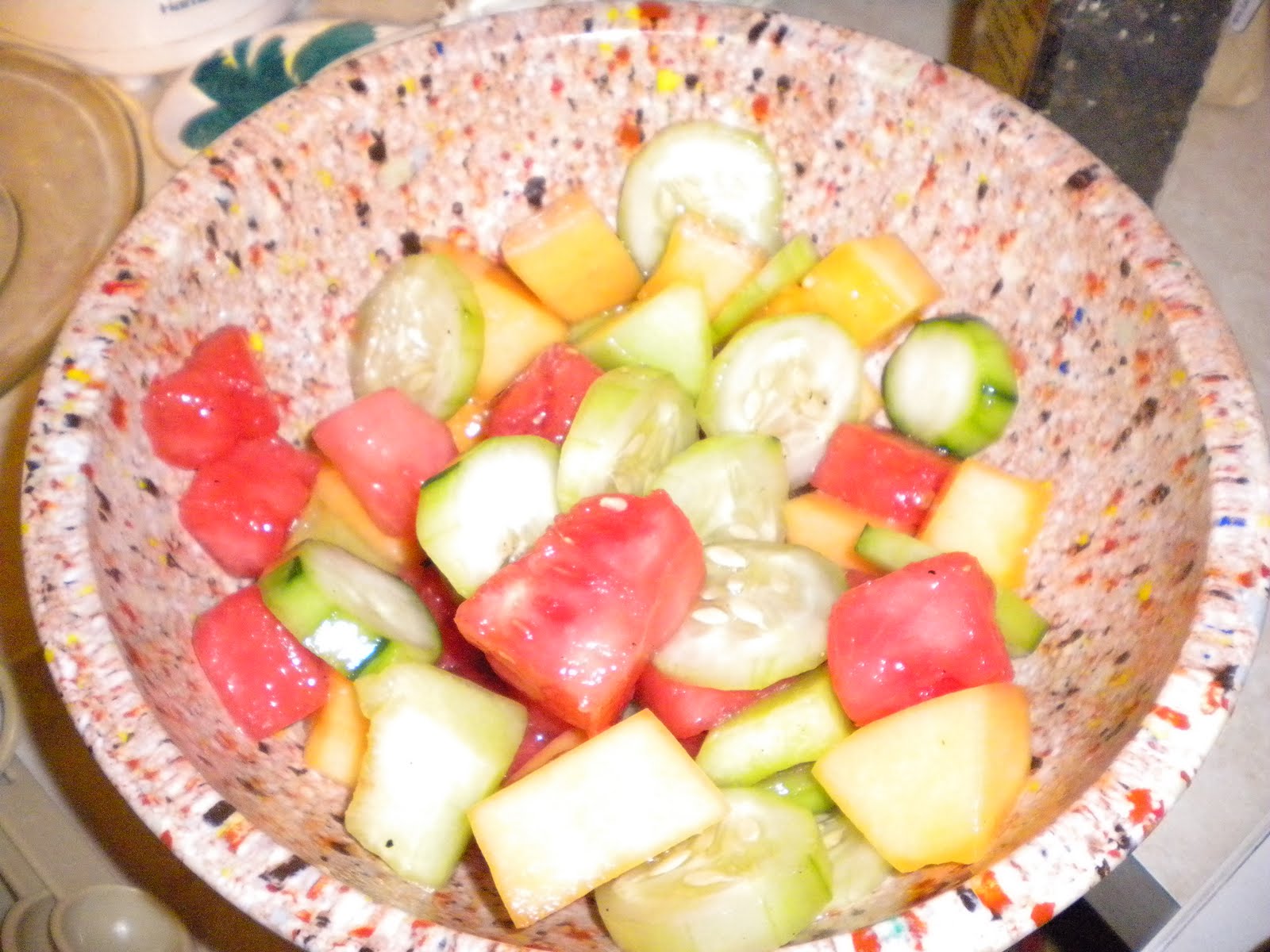
Recipe: Melon Cucumber Salad

Recently I've been into "eating healthier", which means eating more fruits, vegetables, and grains. I figured I'd start off with a salad, and I have to say that this was a great choice. It was a nice little pick-me-up, since February is such a depressingly dreary month. Warning though: it is a summer salad, so the ingredients (specifically the melon) will be slightly more expensive.

Taste: It is wonderfully refreshing. When I first ate this, I thought that it needed a different dressing because I didn't soak the melon for all 8 hours, but I have to say- the longer the melon sits in the oil and dressing, the better it is. The next day, this salad was fantastic, and it definitely did not need a different dressing. So, lesson- soak it for all 8 hours...at least.

Grade: A

Cooking: Extremely easy. The only thing is getting the melon and it has to soak for a while.

Grade: A

I would definitely serve this during the summer at any time.

Here's the recipe:

Melon Cucumber Salad (from Summer Fresh Fruits and Vegetables, 1989)

1/4 cup vegetable oil
2 tablespoons lemon juice
1/2 teaspoon sugar
1/4 teaspoon salt
Dash of freshly ground pepper
3 cups 3/4-inch pieces melon (honeydew, watermelon, cantaloupe)
2 small cucumbers, thinly sliced
Assorted salad greens

Mix oil, lemon juice, sugar, salt, and pepper in tightly covered container; toss with melon and cucumbers. Cover and refrigerate up to 8 hours. Drain; toss with salad greens.

Wednesday, January 26, 2011

Book Review: In the Time of the Butterflies by Julia Alvarez

This book originally caught my eye because in my senior year of college I took a course on the history of the Dominican Republic and had learned all about Trujillo and his horrible, horrible dictatorship. I also read fiction books similar to this one that combined fact and fiction about the regime and the Trujillo era. Thus, I thought I would read this as a "continuation" of my course.

After reading The Feast of the Goat (a fiction book from my course), my professor at the time had said that almost all of Trujillo fiction books were similar and implied that they were a waste of time to read. I have to admit I partially read this to see if he was right, and I have to say that he was.

This book is about 4 sisters, three of whom were assassinated by Trujillo because they were instrumental in starting a revolution to overthrow the government. Dede was the fourth sister who survived. The other three, Maria Teresa (Mate), Minerva, and Patria were nicknamed Las Mariposas (the butterflies). It gives the tale of their revolution from each of their points of view. It gives a fictional background on how they got involved, what happened while they were imprisoned, and even what happened leading right up to their deaths. It gives you details on their family and their hardships, and it tells a story of Dede's hardships after her sisters' deaths.

The book is divided into four parts. The first three parts have 4 chapters in each, one for each sister. The last part is an epilogue that tells the fictional story of what happened to Dede and the rest of the Maribal family after the deaths of the famous sisters. Each sister has her own way of telling her story which is consistent throughout the book. For example, Maria Teresa's chapters are always laid out in a diary format. The other three, though, are basic prose.

I have to say that this book did suck me in. Even though it was similar to other books I had read about this era, I am still intrigued and baffled by the tales that come out of the Trujillo era, or should I say as a result of the Trujillo era. Even though they are almost always the same--Trujillo sleeps around with young (sometimes underaged) girls, he goes on a killing rampage murdering everyone he thinks will rise up against him, he hires spies to listen in on Dominican citizens in a effort to stop an uprising--they always manage to draw me in. And why wouldn't they?! They have violence, suspense, sex, love-all of the ingredients to make for a juicy novel, even if it is cliche!

Other than being cliche, I thought that the author did a poor job of establishing the setting, especially when it came to Dede. I was never sure really when she was in the "present" or when she was reminiscing. Also the dialogue between the reporter and Dede seemed confusing. I couldn't quite get who was who at first.

I'm not sure I would recommend this book. I mean, I think it was okay, but I don't think I'd have someone go out of their way to read it. The only thing that I can say is that it was an easy enough read that it wouldn't take a lot of time, but for someone who doesn't have much background on the Trujillo era, I'm not sure that they'd be that into it.

Grade: C

Saturday, January 22, 2011

Book Review: At Home in the Muddy Water by Ezra Bayda

I just got done reading this book, and I have to say I was really impressed. It took me a couple of weeks to read it not because it was difficult, but because I found that I really just wanted to absorb the material.

After reading Krishnamurti's book, I have to say that this was a great follow up. Bayda provides the reader with a lot of tips on meditation and Zen practice as well as some guidance on what one should be focusing on when practicing. For me, this was really important seeing as how I'm often wondering if "I'm doing it right" or if I'm just going around in circles.

He divides his book into several different parts. In the first part, he lays out "What Practice Is." He introduces it by talking about our ego or the state of being cut off from our awareness of our True Self. He labels this our "substitute life." He talks about how we all have strategies that we use to escape fears that take over our lives. I think one of the most important statements he makes in this part which sums up the purpose of spiritual practice is the following:

"Genuine spiritual practice is never about fixing ourselves, because we're not broken. It's about becoming awake to who we really are, to the vastness of our True Nature, which includes even the parts of ourselves we label as "bad"."

I think one of the most enlightening and assuring points of this part was that he talks about how every person who practices "fails". They get discouraged, confused, often times taking a break or temporarily leaving the practice. He gives suggestions and talks about the different phases of discouragement and how to overcome them. I thought this was particularly reassuring since I often wonder if it is normal for me to have those feelings. He basically says that it is all part of a person's path.

I also really liked how he stressed what clear seeing actually is, and what practicing is actually about, or better yet, he gives you a broad, yet clear indication of what practicing will end up making a person see about themselves.

"Clear seeing is not the same as psychoanalyzing; we're not focusing on the past or trying to figure out why we think or behave as we do. This is an important point. We're simply attempting to observe ourselves as we are. As we begin seeing through our beliefs and strategies, we inevitably find judge and find fault with ourselves. But part of the practice of clear seeing is to observe our mind's tendency to judge and to notice how often we're not even aware of accepting our judgments as truth."

What a statement- we're not even aware of accepting our judgments as truth. This was the part that really drew me in. I think about how often I judge people or things or situations and my mind instantly takes these statements as truths. In fact I even managed to practice with that in mind for a day-watching my judgments and seeing how quickly I treat them as fact. I can tell you it's amazing what you find out about yourself.

In the next part of the book-"Attachment and Ideals"-Bayda starts off by talking about attachments. He describes attachments as the following:

"Attachments are simple beliefs-fantasies, in fact- that have become solidified as "truth" in our mind. They also partake of the energy of desire, which is based on the underlying belief that without some particular person or thing, we can never be free from suffering. Attachment also takes the form of avoidance; we believe we can't be happy as long as a particular person, condition, or object is in our lives."

This chapter on attachments led into the next chapter- addiction. Bayda opens up with the premise that we are all addicted to comfort. He talks about how each of us manipulate our lives, our thoughts, our beliefs to find comfort and avoid pain. He talks about how we are also addicted to our thoughts, our self-judgments, and our identities.

In the third part, Bayda talks about relationships. To me, this was the eye-opener of the book, but there were also points that I have to question.

Bayda starts off with this strong point:

"This is a key point; almost all of our relationship difficulties come from wanting something or someone to be different."

Think about your own relationships and hard times. Why did you have them? Because he/she wasn't giving you something you wanted or felt you needed? Exactly. Bayda argues that we were taught that relationships are supposed to give us something to make us feel better. As a result, we walk into every relationship (romantic, friendships, parental, etc.) with expectations, preferences, requirements. This transitions into the fact that we care for someone as long as they satisfy our needs and make us feel a special way.

He moves on to talk about how we transmit those expectations, "needs", etc. on to the other person, turning them into something they aren't, forcibly involving them in an unspoken pact that they have to meet these expectations. When that person doesn't (not if...when, because it is inevitable), we are exposed to fear and hurt, turning the other person into our enemy.

How do we move past this? How can we experience a relationship without all of these expectations? Bayda proposes that we have to learn to stop blaming others when we find ourselves in the middle of an emotional conflict. This means that we have to realize that all of our emotional distress comes from something we ourselves created. When we start to see this, we start to see our expectations and as we dig deeper, we see that these expectations actually come from our own fears and insecurities such as rejection or feelings of unworthiness.

I think the chapter that I had the hardest time agreeing with was the chapter on trust. Bayda proposes that when we feel as though our sense of trust has been shaken it is once again because our projections and expectations have been rejected. We feel groundlessness and pain. So far, I agree. However, as he moves into this topic he talks about how we need to deal with our projections and expectations and once we do, we will find that trust is almost a null topic because we will come to trust everyone. I suppose my problem with this is where do you draw the line? For example, if a person hits me, is my sense of trust not supposed to be shaken? At what point do I stop eliminating my expectations in a person? I agree that trust is more of a standard and mechanism to bar ourselves from fear, but at the same time, is it not needed so we aren't abused or taken for granted? Just something to think about.

All in all, I really enjoyed this book, and I would highly recommend it to someone who is interested in practicing or is even interested in spirituality. It makes you think and it definitely forces you to look at yourself, your thoughts, feelings, judgments, etc. Great read.